Entry 001 · Mannheim, Germany, 1886
The 1886 Benz Patent-Motorwagen: The First Automobile Ever Built.
On 29 January 1886, the Imperial Patent Office in Berlin granted Karl Benz German patent number DRP 37435 for a "vehicle with gas engine operation." Three wheels. One cylinder. Roughly two-thirds of a horsepower. A tiller where the steering wheel had not yet been invented. Every automobile made since, 1.6 billion of them still on the road today, is a descendant of this machine.
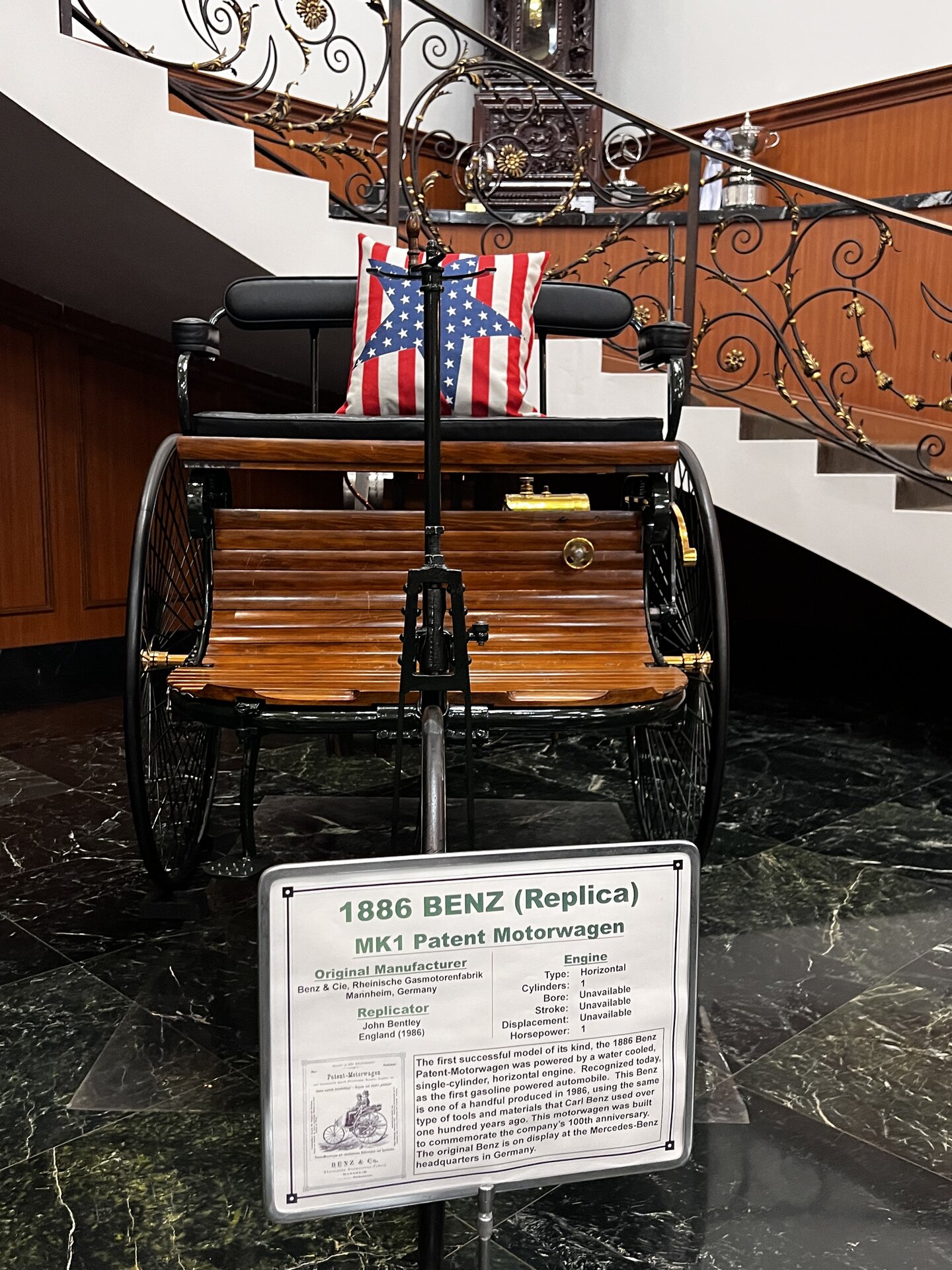
Before this vehicle, "automobile" was not a category. There were carriages, and there were locomotives, and there were bicycles. Karl Benz combined the three, added a four-stroke internal-combustion engine of his own design, and defined a machine class that would go on to reshape every city and every economy on Earth. The line is that clean. History begins here.
Specifications
- Year
- 1886
- Manufacturer
- Benz & Cie.
- Mannheim, Germany
- Patent
- DRP 37435
- Granted 29 Jan 1886
- Wheels
- Three
- two rear, one front
- Engine
- Horizontal single
- four-stroke, water-cooled
- Displacement
- 954 cc
- 58.2 cu in
- Output
- ≈ 0.75 hp
- at 400 rpm
- Steering
- Tiller
- rack-and-pinion, front wheel
Karl Benz, one cylinder, three wheels.
Karl Benz was a mechanical engineer in Mannheim who had already built a two-stroke stationary engine and a four-stroke of his own before he ever put wheels under one. The Patent-Motorwagen was not an improved carriage. It was designed, from the ground up, around the engine. That is why it has three wheels instead of four: in 1886 there was no reliable way to steer two front wheels together, so Benz used one front wheel on a rack-and-pinion tiller and put the engine where a fourth wheel would have gone. The chassis is tubular steel, welded and brazed, not a carriage frame at all. This is engineering thinking, not carriage thinking.
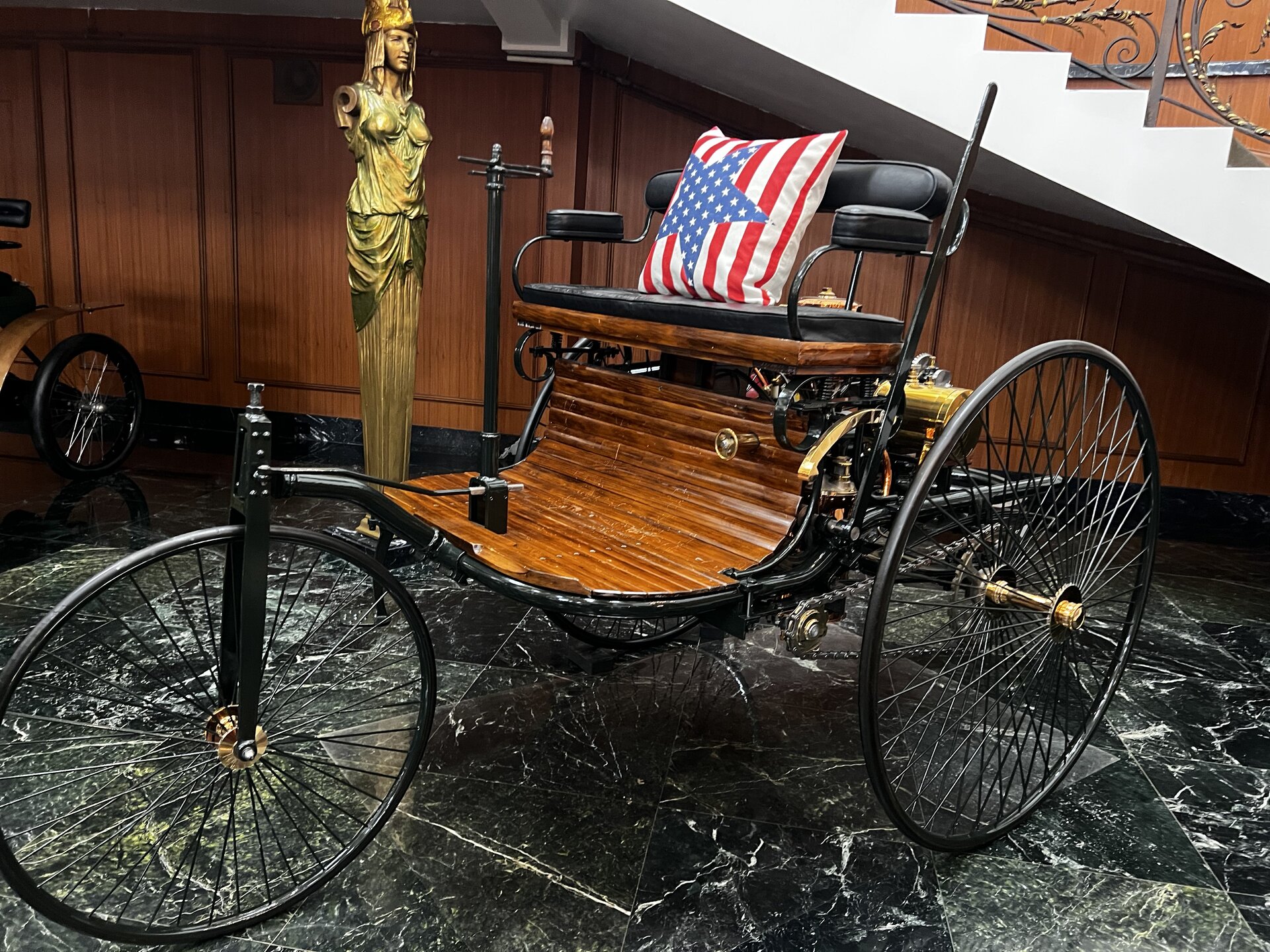
The overhead view tells you what the side view hides.
Walk around to the back and look down. The horizontal single-cylinder engine is fully exposed. So is the enormous cast-iron flywheel that Benz laid flat, because he was worried a vertical flywheel would create dangerous gyroscopic forces at speed. The belt drive runs from the engine to a countershaft, then chain drives to the rear axle. There is no gearbox. There is no differential yet. There are no brakes worth the name, just a leather-lined block that presses against the belt pulley. You are looking at every mechanical decision that the next 140 years of car engineering had to argue with and eventually replace.
Bertha Benz and the first road trip.
In August 1888, without telling her husband, Bertha Benz loaded her two teenage sons into the Model III Patent-Motorwagen and drove roughly 106 kilometres from Mannheim to Pforzheim, becoming the first person to drive an automobile any real distance. She refuelled with ligroin from a pharmacy in Wiesloch, the first filling station in history by accident. She cleaned a blocked fuel line with a hatpin. She used her garter as an insulator on a shorting ignition wire. She had a cobbler nail leather onto the wooden brake block because the brakes were failing on descents, inventing the brake lining. Karl found out because she sent him a telegram. Ninety percent of what is now considered "the automobile industry", refueling infrastructure, roadside repair, brake pads, road-worthy testing, was invented in a single day by a woman using improvised tools on a machine her husband had told her not to drive.
Why the first automobile matters to Physical AI.
I did not travel to see this vehicle to admire it as an antique. I went because it is the honest baseline. In 1886, the entire installed base of automobiles was one. In 2026, it is roughly 1.6 billion. Every one of those vehicles is a lineal descendant of this three-wheeled machine, and every one of them was designed around a human driver, because in 1886 there was no other option. The question I work on at Outonomous is the mirror-image question: how do you take that installed base, the 1.6 billion vehicles the Patent-Motorwagen founded, and give them the one thing Karl Benz could not, autonomy, without waiting for them to be replaced one at a time over the next forty years? Karl Benz gave the world the automobile. The next step is giving those automobiles the ability to drive themselves. That is the mission: 100 million lives saved by moving Physical AI onto the vehicles that already exist.
"There is a straight line from this tiller to every steering wheel on Earth. There is another straight line, still being drawn, from every steering wheel on Earth to no steering wheel at all. Both lines pass through Karl Benz."
Omar Mukhtar, field note
Background reading
For further reading: Benz Patent-Motorwagen (Wikipedia), Karl Benz (Wikipedia), Bertha Benz (Wikipedia), and the Mercedes-Benz Museum, which holds the original Patent-Motorwagen in Stuttgart.
Copyright
Photographs © 2026 Outonomous. All rights reserved. Image rights are held by Outonomous and may not be reproduced without written permission.