Entry 002 · Eisenach, Germany, 1898
The 1898 Eisenach Runabout: The First Car From the Factory That Became BMW.
The 1898 Eisenach Runabout is the first automobile built by Fahrzeugfabrik Eisenach AG, a small arms and machinery works in Thuringia, Germany. In 1928 Bayerische Motoren Werke bought that same factory to enter the car business. Every BMW ever made traces its corporate lineage back to this two-cylinder, ten-horsepower, solid-rubber-wheeled machine, thirty years before the roundel existed.
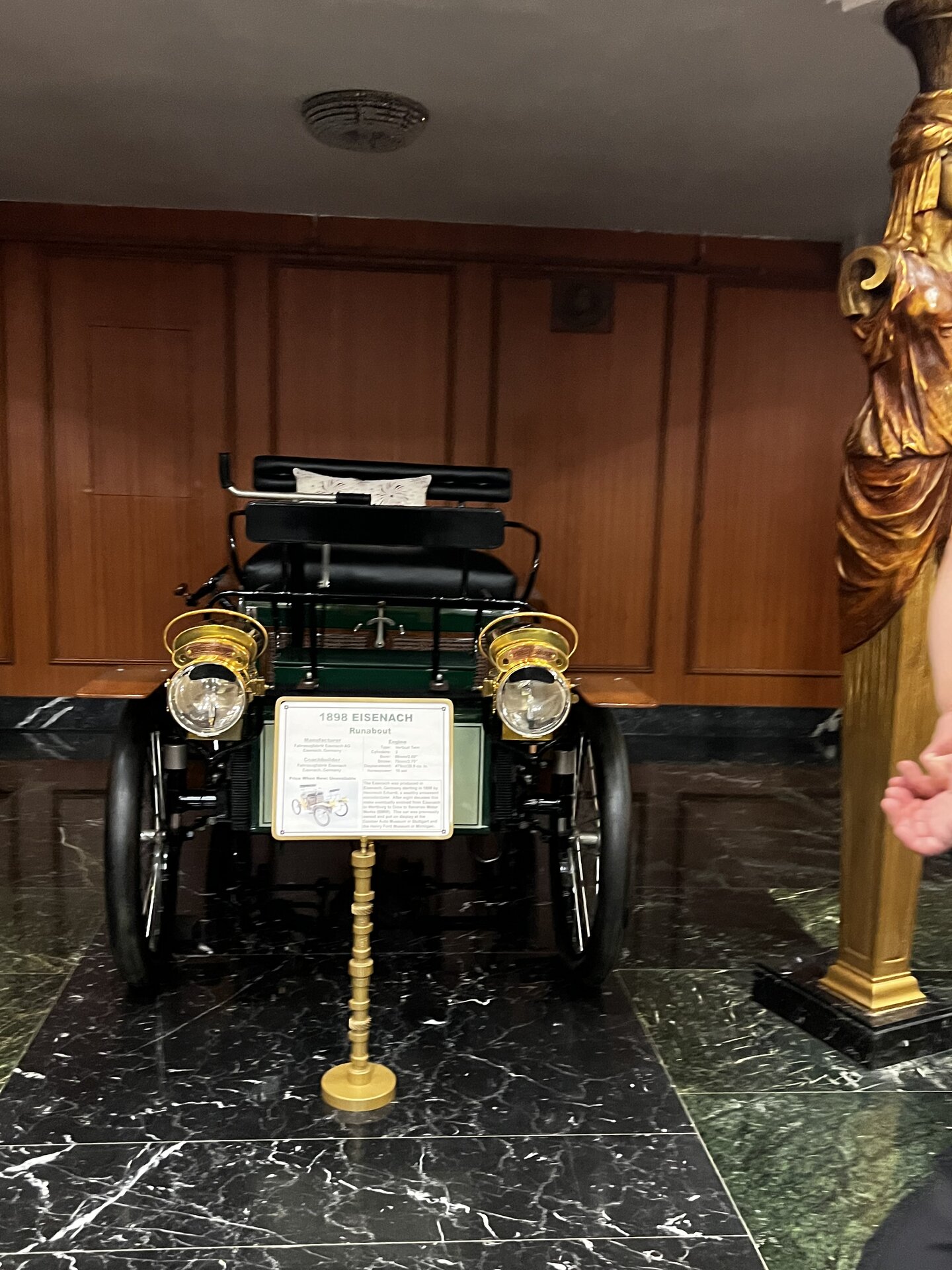
Every M3, every 507, every straight-six that ever howled down the Nürburgring is descended from this cheerful little green carriage. This is not a metaphor. It is corporate genealogy. The factory that produced this Runabout in 1898 is the factory Bayerische Motoren Werke bought in 1928 to enter the automobile business. Everything with a roundel starts here.
Specifications
- Year
- 1898
- Manufacturer
- Fahrzeugfabrik Eisenach AG
- Eisenach, Germany
- Coachbuilder
- Fahrzeugfabrik Eisenach
- in-house
- Engine
- Vertical Twin
- 2 cylinders
- Displacement
- 479 cc
- 28.9 cu in
- Bore × Stroke
- 66 × 70 mm
- 2.59" × 2.75"
- Output
- ≈ 10 hp
- estimated
- Steering
- Tiller
- not a wheel
Heinrich Ehrhardt, gun barrels, and a horseless carriage.
Heinrich Ehrhardt made his fortune the century's most reliable way: gun barrels. In 1896 he pointed the same precision machinery at a stranger idea, the horseless carriage, and in 1898 the first Wartburg-branded car rolled out of Thuringia. It was licensed from the French Decauville and quietly improved by German engineers who could not resist tightening a tolerance. Two cylinders. Ten horsepower. Solid-rubber wheels. A pair of brass Phare Solar lamps big enough to light the next century.
A machine that half-believed it was still a carriage.
Look closely at the photograph. The steering is a tiller. The driver sits behind the passenger, the older carriage seating hierarchy still intact. The dashboard is caned, like a Parisian bistro chair. The bodywork is forest green over black, hand-finished, riveted, unhurried. Here is a genuinely novel observation from standing beside it: the Runabout has no windshield, no fenders, no throttle pedal, and yet the brass Phare Solar headlamps are already larger and more finished than the entire engine bay. In 1898, lighting was still an evening-carriage problem inherited from horse tack. The engineering brief was not "build a car." It was "build a carriage that does not need a horse." Everything downstream of BMW is what happens when engineers stop apologising for that.
From Fahrzeugfabrik Eisenach to Dixi to BMW.
Fahrzeugfabrik Eisenach was renamed Automobilwerk Eisenach and its cars were marketed as Dixi from 1904. In 1928, Bayerische Motoren Werke, then still an aero-engine and motorcycle house from Munich, bought the Eisenach plant and with it an entry ticket into automobiles. The Dixi 3/15, an Austin Seven licence-build assembled on this same shop floor, was rebadged as the BMW 3/15. That was the first BMW car.
Everything after is a straight line. The 328 that terrorised Mille Miglia in 1940. The 507 that broke Elvis Presley's heart and every subsequent bank account. The 2002 that taught America what a sports sedan was. The M3 that became a verb. The i8. The XM. Every one of them is a great-great-grandchild of the green carriage in this photograph.
Why this vehicle matters to Physical AI.
The Runabout is not a museum curiosity for me. It is the reason Outonomous builds its Physical AI platform for existing vehicles. The automobile did not start from a clean sheet in 1898. It started as a carriage without a horse, then absorbed decades of iteration on the same chassis, the same factory, the same engineers. Autonomy will arrive the same way: not on a new car built from scratch, but installed on the 1.6 billion vehicles already on the road. Ten horsepower and a tiller became the M3 because the factory kept iterating on what already existed. Autonomous driving will scale for the same reason.
"There is no BMW without this Runabout. Not the badge, not the factory, not the engineers, not the habit of treating a car as a precision instrument. It all starts on a solid-rubber wheelset in Eisenach, 1898."
Omar Mukhtar, field note
Provenance
This 1898 Eisenach Runabout has been displayed at The Henry Ford in Dearborn, Michigan, and the Daimler Museum. Photographed first-hand by me for Outonomous.
Background reading: Automobilwerk Eisenach (Wikipedia), Wartburg (car) (Wikipedia), BMW Dixi (Wikipedia), and the official BMW Group corporate history.
Copyright
Photograph © 2026 Outonomous. All rights reserved. Image rights are held by Outonomous and may not be reproduced without written permission.