Entry 005 · Cleveland, Ohio, 1917
The 1917 Owen Magnetic Model 60: The Car of a Thousand Speeds.
In 1917, when almost every automobile on Earth was still learning how to change gears without stripping them, the Owen Magnetic did not have any. The engine spun an electromagnet. The electromagnet spun the wheels. Nothing in between them ever touched. You could pass a sheet of paper through the drivetrain with the engine running. This is a first-hand study of the Nethercutt Museum's 1917 Model 60 display chassis, a car that was, in every meaningful sense, a series hybrid built a hundred years before that word existed.
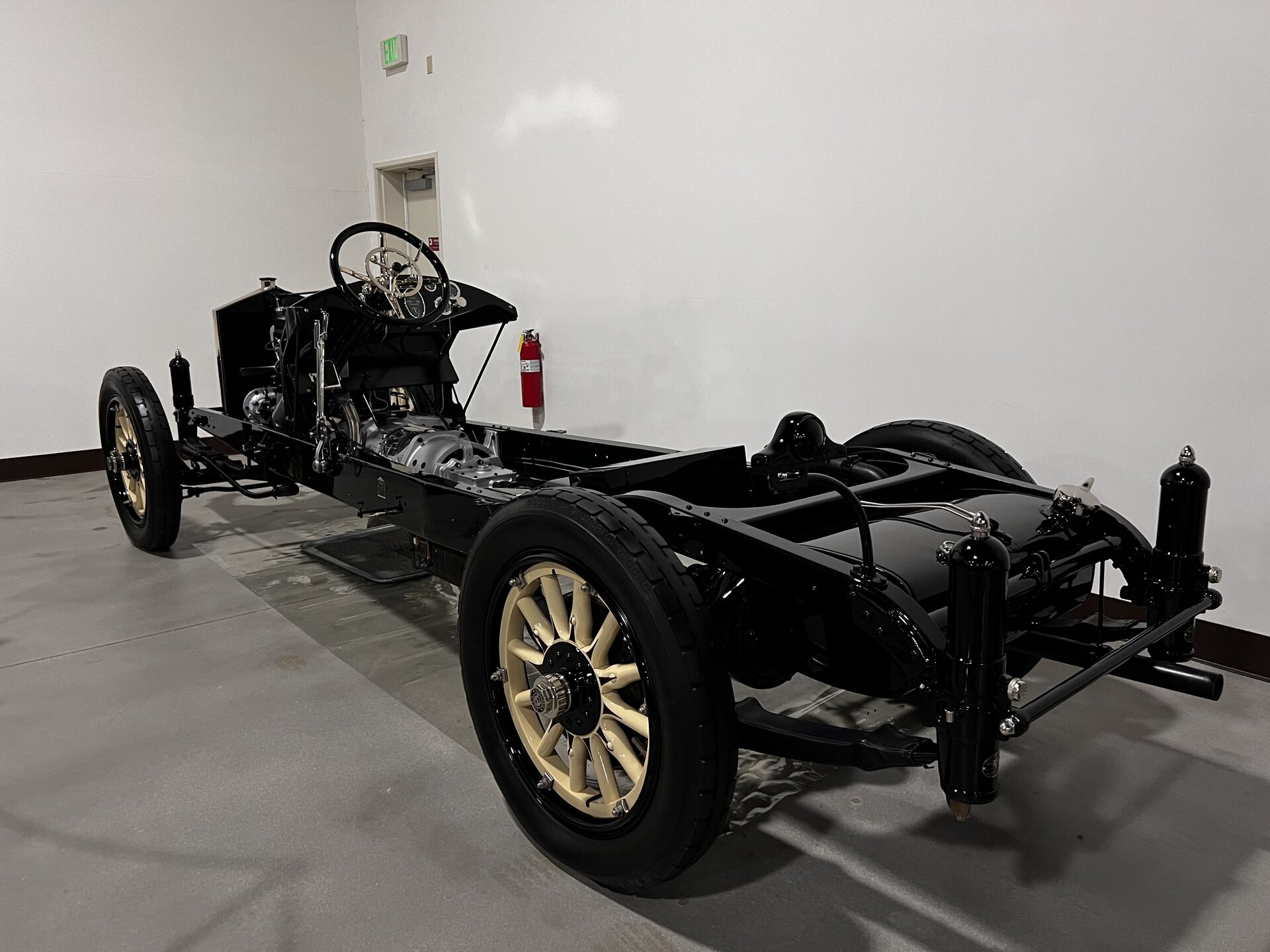
Every other 1917 automobile was a mechanical argument between an engine that wanted to spin at a fixed rate and wheels that needed to spin at whatever rate the road demanded. Clutches, gearboxes, and driveshafts existed to negotiate that argument, badly. Justus B. Entz ended the argument by removing it. His transmission replaced friction with a magnetic field. The result was the smoothest, quietest, and most expensive drivetrain of its decade, and the direct ancestor of every modern electric drivetrain on the road today.
Specifications
- Year
- 1917
- Manufacturer
- Baker R. & L. Co.
- Cleveland, Ohio
- Body
- Display chassis
- unbodied
- Engine
- Straight six
- 3.5" bore, 5" stroke, 303 cu in
- Output
- ≈ 75 hp
- side valve
- Transmission
- Entz magnetic
- no mechanical link
- Price when new
- $6,000
- chassis only, ≈ $150k today
- Marketing
- "1,000 Speeds"
- infinitely variable
Justus Entz and the mechanical problem he refused to accept.
Justus Bulkley Entz was a Thomas Edison man, one of the engineers who cut his teeth at the Edison Electric Light Company in the 1880s and then spent the rest of his career trying to make electric motors do more work than gasoline engines. In the 1890s he designed a gasoline-electric hybrid drivetrain for the Electric Vehicle Company. In 1914, working with the Entz Motor Car Corporation, he patented the transmission that would carry his name. His premise was simple and, to almost every other automotive engineer in America, obviously wrong: the gearbox is a bad idea. A machine that has to physically break the connection between engine and wheels twenty times an hour, using a friction disc and a set of sliding gears cut to tolerances the industry could not reliably hold in 1917, will always be the noisiest, most fragile, and most driver-hostile part of the car. Remove the mechanical link and you remove the problem. The rest of the industry ignored him. Ray M. Owen did not.
How the Entz drive actually works.
Look at the chassis. Where any other 1917 car has a bell housing, a clutch, and a gearbox, the Owen Magnetic has a single cylindrical assembly bolted directly to the back of the engine. Inside that cylinder are two things that never touch. The engine's crankshaft spins the outer field, a cast-iron drum wound with copper and energized by a battery. Suspended inside the field, connected to the driveshaft, sits the armature. There is an air gap between them. When the field is energized, its magnetism drags the armature along with it, and the driveshaft turns. The driver's only control is a small lever on the steering column that varies the current through the field. More current, stronger field, tighter magnetic coupling, more torque to the wheels. Less current, weaker field, the armature slips, the car eases off. There are no gears to select. There is no clutch to slip. The engine can run at its most efficient rpm continuously while the car accelerates from a stop to top speed through a continuum of magnetic couplings. Owen's marketing department called it a thousand speeds. It was, in fact, infinite.
The second machine: regenerative braking, in 1917.
The Entz transmission is not one machine. It is two. The same field-and-armature assembly that propels the car can be electrically reversed to become a generator. When the driver lifts off, the wheels are now driving the armature through the driveshaft, spinning it inside the field. That motion generates current, which is fed back to the batteries. The car slows down not because a brake pad is dragging on a drum, but because the physics of turning a generator takes work, and that work comes out of the car's kinetic energy. This is regenerative braking, decades before the term entered the automotive vocabulary. The Owen Magnetic still had a mechanical emergency brake, a leather-lined band that clamped a drum on the driveshaft, because 1917 electrical systems were not something you bet your life on. But in normal driving, the car stopped by turning its own momentum back into stored electricity. Every Tesla, every Prius, every electric city bus in the world is running a more sophisticated version of exactly this idea.
Why Enrico Caruso bought one.
The Owen Magnetic was expensive. A bare chassis, no body, cost $6,000 in 1917, at a time when a Ford Model T was $360 complete and a middle-class house in most American cities sold for less than the chassis alone. Bodied, an Owen Magnetic could easily land north of $8,000. The customers were the kind of people who could pay that. And, revealingly, the customer list skews hard toward professional musicians. The two most famous Owen Magnetic owners were Enrico Caruso, the operatic tenor, and John McCormack, the Irish lyric tenor, both men who had spent their entire adult lives training their ears to detect mechanical noise at the threshold of human hearing. Owen sold to them because the Magnetic was, by an order of magnitude, the quietest and smoothest car in production. There was no gear whine because there were no gears. There was no clutch shudder because there was no clutch. The engine could be held at a constant, well-muffled rpm while the car accelerated. For a tenor who lived out of hotels and needed to arrive at the opera house with his nervous system intact, this was worth the money.
Why it died, and what killed it.
The Owen Magnetic was in production, on and off through several corporate reorganizations, from roughly 1915 to 1922. It died for the same reason every technically superior early automobile died. Cadillac introduced the electric self-starter in 1912, and by 1917 electric starting had made the manual crank obsolete on any car that mattered. Once you no longer had to break your wrist to start the engine, the second largest complaint about a gasoline car, gear changing, could be handled with better synchromesh gearboxes for a tiny fraction of the Owen's cost. The Entz drive was heavier than a conventional transmission, drained the battery on long uphill runs, and required specialist knowledge to service. It was a Rolls-Royce-priced answer to a question the rest of the industry was solving for the price of a bicycle. By 1922 the Owen Magnetic company was gone. The idea it embodied, though, an engine tuned to a constant rpm powering the wheels through an electrical intermediary that could also recover energy under braking, went dormant for eighty years and then came back as the entire modern hybrid and electric vehicle industry.
Why this matters to Physical AI.
I did not stop at this chassis because I like old cars. I stopped because it is a working monument to a principle I run Outonomous on: the correct place to add intelligence to a vehicle is between the power source and the wheels, in the layer that no one has been able to make elegant with pure mechanics. Entz's answer in 1917 was an electromagnet. Our answer in 2026 is a compute stack, a sensor suite, and a set of learned policies that sit between the driver, the drivetrain, and the road, on the 1.6 billion vehicles that already exist. Both answers reject the same premise: that the car has to be redesigned from scratch to be improved. Entz did not redesign the car. He replaced the worst part of the car with a better part. Outonomous does not replace the car either. It installs the missing intelligence layer on the fleet the world already owns, and turns those vehicles into autonomous machines. 100 million lives saved is the arithmetic that comes out of that.
"The Owen Magnetic proved, a hundred years ago, that if you refuse to accept the worst part of a machine, you can replace it. The wheels do not care whether they are turned by gears or by a magnetic field. What we do at Outonomous is the same move, one layer up. The vehicle does not care whether it is driven by a person or by a policy. Only the outcome cares."
Omar Mukhtar, field note
Background reading
For further reading: Owen Magnetic (Wikipedia), Justus B. Entz (Wikipedia), Enrico Caruso (Wikipedia), and the Nethercutt Collection, where this Owen Magnetic Model 60 chassis is on display in Sylmar, California.
Copyright
Photographs © 2026 Outonomous. All rights reserved. Image rights are held by Outonomous and may not be reproduced without written permission.