Entry 004 · Antwerp, Belgium, 1928
The 1928 Minerva Type AM: General Billy Mitchell's Silent Belgian Machine.
This is the personal car of the man who was court-martialed by the United States Army in 1925 for insisting that air power would decide the next war, and who was posthumously vindicated by every major event between Pearl Harbor and Hiroshima. Brigadier General Billy Mitchell bought a Minerva because it was the quietest engine money could put in a chassis in 1928. He spent his life next to aero engines. When he sat down, he wanted silence. This is a first-hand study of his Type AM Convertible Town Cabriolet, on display at the Nethercutt Museum.
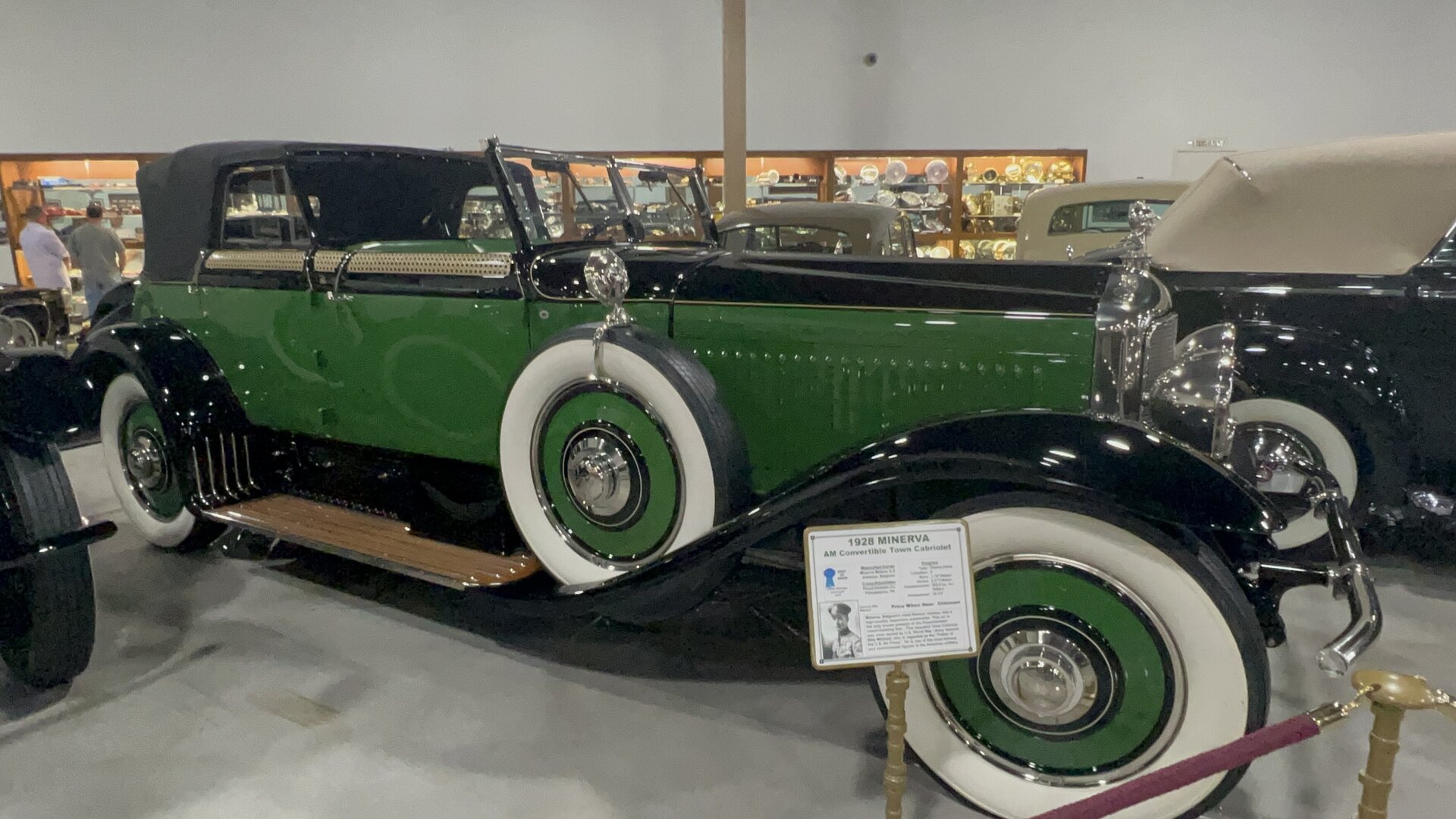
Almost every luxury car of the 1920s made its refinement claim by adding cylinders, ironing out the vibration with mass and metallurgy. Minerva made its claim by removing something instead: the poppet valve. The Knight sleeve-valve engine at the front of this car has no valve springs, no lifters, no clatter. It is arguably the smoothest and quietest six-cylinder built anywhere in the world in 1928, and it landed under the hood of a man whose day job was standing next to open-cockpit aero engines. That is not a coincidence. That is a specification.
Specifications
- Year
- 1928
- Manufacturer
- Minerva Motors S.A.
- Antwerp, Belgium
- Body
- Convertible Town Cabriolet
- Type AM
- Coachbuilder
- Floyd-Derham Co.
- Philadelphia, PA
- Engine
- Knight sleeve-valve six
- 3.543" bore, 5.512" stroke
- Displacement
- 363.35 cu in
- ≈ 5.9 L
- Rating
- 32 / 100 hp
- tax hp / brake hp
- First owner
- Gen. Billy Mitchell
- U.S. Army Air Service
Minerva of Antwerp: from bicycles to the Belgian Rolls-Royce.
Minerva was founded in Antwerp in 1902 by Sylvain de Jong, a Dutch émigré who had been building bicycles since 1897. Within six years the firm had moved from bikes to motorcycles to cars, and by the outbreak of the First World War it was the most prestigious carmaker in Belgium, supplying King Albert I, the King of Sweden, Henry Ford, and a long list of European aristocracy. Antwerp was overrun by the German army in 1914; the factory was seized and produced munitions for the occupier through the war. When peace returned in 1919, Minerva rebuilt around a single strategic bet: the Knight sleeve-valve engine, an American design licensed from Charles Yale Knight of Chicago, which the company staked its post-war identity on. By 1928, when this Type AM was built, Minerva sat directly opposite Rolls-Royce in the European luxury market and outsold it in several countries.
Charles Yale Knight and the war on the poppet valve.
A conventional 1928 engine breathed through poppet valves: mushroom-headed metal plugs held shut by heavy coil springs, hammered open by a rotating camshaft, slammed closed twenty times a second at cruise. It worked, but it was loud, mechanically brutal, and required constant adjustment. Charles Yale Knight, a Wisconsin-born newspaper publisher with no formal engineering training, decided in 1901 that this was ridiculous. His replacement design used two thin, precisely machined metal sleeves that slid up and down inside each cylinder, between the piston and the cylinder wall. Ports cut into the sleeves aligned with ports in the cylinder to admit intake charge and vent exhaust. There were no springs. There was nothing to slap open or shut. Daimler in England adopted the Knight system in 1908 to public acclaim; Panhard in France followed; Minerva in Belgium committed to it earlier than either and rode it hardest. A Knight engine at idle is famous for a single characteristic: you cannot tell, standing next to the car, whether it is running.
Why silence matters, and why it costs money.
The trade-off Charles Yale Knight demanded of his customers was, at the time, considerable. Sleeve-valve engines burn a little more oil than poppet-valve engines because the sliding sleeves are oil-lubricated on the working surface, and some of that oil unavoidably enters the combustion chamber. They are heavier for a given displacement. They require higher machining tolerances, which means they are expensive to build. In exchange, they produce dramatically less mechanical noise, less vibration, and, in the specific case of Minerva's 363 cubic inch six, torque delivery so smooth that period road tests describe the car as accelerating "like a heavy door swinging closed on well-oiled hinges." The two rating figures on the specification plate, 32 and 100, refer to two different things: the Belgian tax horsepower (a fiscal calculation based on cylinder dimensions) and the actual brake horsepower on a dynamometer. The car pays tax as if it were a small engine and drives as if it were a large one, which was the entire point of the Belgian rating system and part of why Antwerp built cars this way.
Floyd-Derham of Philadelphia: the American body on the Belgian chassis.
This car left Antwerp as a bare running chassis. In the 1920s the standard practice for a serious luxury purchase in the United States was to import the chassis and commission a domestic coachbuilder to build the body around the buyer's specification. Mitchell's Minerva was bodied by the Floyd-Derham Company of Philadelphia as a Convertible Town Cabriolet, a specific style with a distinct social meaning: the chauffeur sits in an open front compartment, exposed to the weather; the owner and any guests sit in an enclosed, weatherproof rear compartment. The dividing partition, the crank-up rear window, and the private folding jump seats all belong to a world of formal calls, opera nights, and social visits that vanished with the 1929 crash. The woven cane detailing running along the shoulder line of the body is not real basketwork. It is painted trompe-l'œil, a nineteenth-century carriage-maker's trick that Floyd-Derham applied to signal that the car was, in its bones, a horse-drawn town carriage translated into steel and gasoline.
Billy Mitchell: the man who was court-martialed for being right.
William "Billy" Mitchell (1879 to 1936) is one of the very few American officers whose ideas were so aggressively unwelcome to his own service that the Army convicted him of insubordination and forced him out, and one of the even fewer whose ideas were so obviously correct that the Air Force later named its second-generation strategic bomber after him. Mitchell commanded American air combat operations in France in 1918, returned to the United States convinced that the aeroplane would render surface navies obsolete, publicly sank captured German battleships from the air in 1921 to prove it, was systematically demoted for continuing to say so, and was court-martialed in 1925 after publicly accusing War Department leadership of "almost treasonable administration" following a naval airship disaster. He resigned rather than accept the sentence and spent the last decade of his life as a civilian advocate. He died in 1936, five years before the Japanese Navy proved him right at Pearl Harbor. This Minerva belongs to that civilian decade. He drove it. He was driven in it. He argued the future of air power out of the back seat of it.
Why this car matters to Physical AI.
Mitchell's argument, reduced to its skeleton, is the argument I make every day at Outonomous. A new technology arrives. The institutional incumbents insist that the existing platform (battleships, in Mitchell's case; the human-driven vehicle, in ours) is fine and that the new technology is a curiosity. The people closest to the new technology can see, in advance, that the incumbent platform is about to become a liability. The gap between when they can see it and when the rest of the world will admit it is measured in a decade, and it is paid for in lives. Mitchell tried to close that gap in the 1920s and was destroyed for it. The gap I am trying to close is the one between what Physical AI can already do on the road today and the 1.6 billion vehicles still being driven by humans who kill roughly 1.3 million of each other every year. Outonomous is the platform that installs autonomy on the vehicles that already exist, so that closing the gap does not require waiting forty years for the world's fleet to be replaced. 100 million lives saved is the arithmetic. The Minerva is a reminder that arithmetic like this rarely gets a hearing on the first pass.
"Mitchell was right about air power, and the institution punished him for it. The lesson is not that institutions are bad. The lesson is that the gap between what a technology can already do and what the incumbent will let it do is where lives are lost. Physical AI is standing in that gap right now."
Omar Mukhtar, field note
Background reading
For further reading: Minerva (Wikipedia), Sleeve valve (Wikipedia), Charles Yale Knight (Wikipedia), Billy Mitchell (Wikipedia), and the Nethercutt Collection, where this Minerva is on display in Sylmar, California.
Copyright
Photographs © 2026 Outonomous. All rights reserved. Image rights are held by Outonomous and may not be reproduced without written permission.