Entry 003 · Indianapolis, Indiana · 1923
The Duesenberg Model A pioneered the four-wheel hydraulic brake.
In 1923, the Duesenberg Model A Phaeton cost $6,500, a massive sum that bought the world's first production application of four-wheel hydraulic brakes. Utilizing a 260 cubic inch SOHC Straight-8 engine, this vehicle brought Indianapolis racing pedigree to the public road. It remains a benchmark for early twentieth-century mechanical integrity and stopping power.
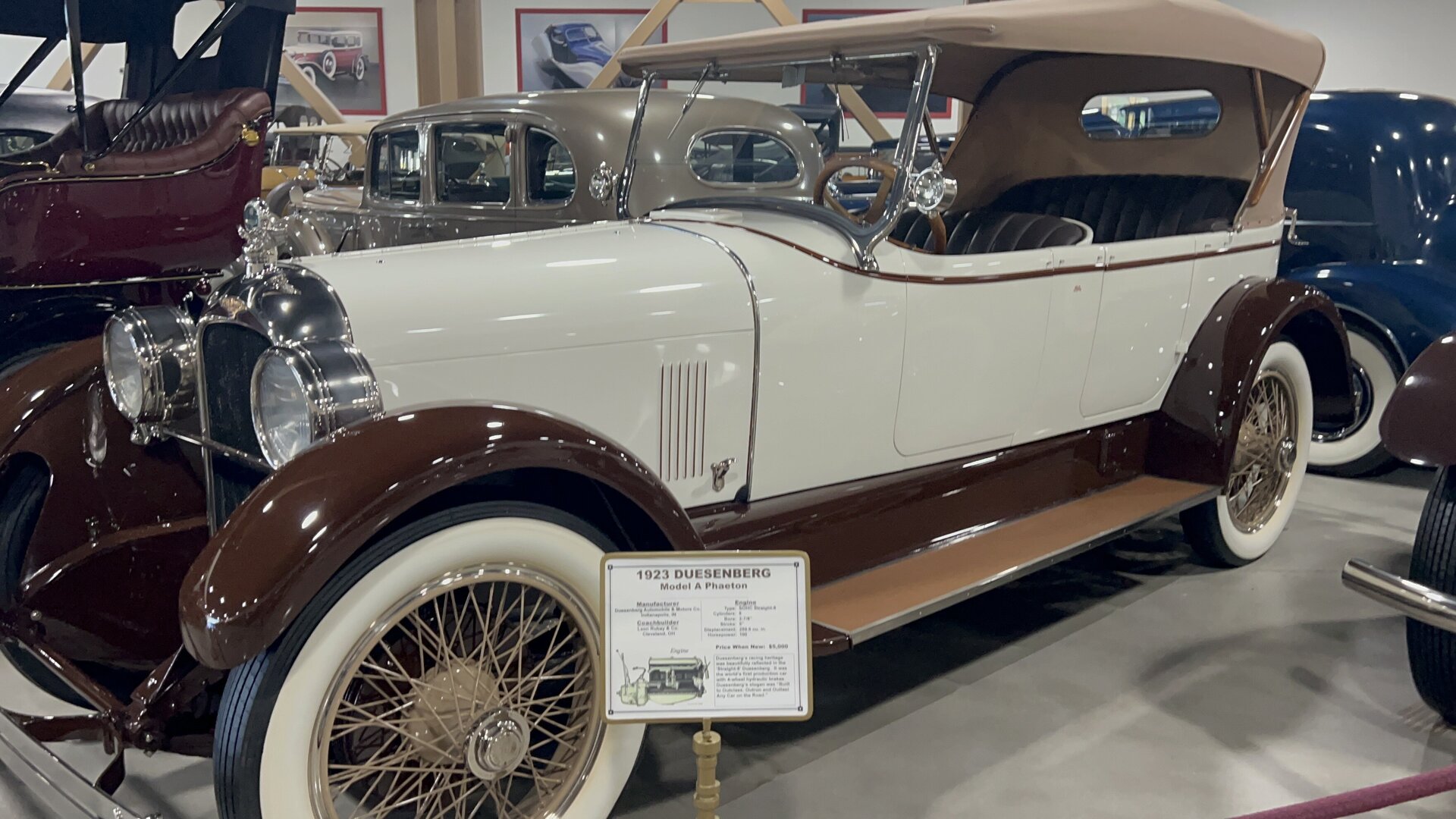
The 1923 Duesenberg Model A Phaeton serves as a physical record of the moment racing technology transitioned to the consumer market. While competitors were content with rear-wheel mechanical braking, the Duesenberg Automobile and Motors Company introduced the first production four-wheel hydraulic braking system. This was not a luxury gimmick but a functional necessity for a vehicle powered by a 100-horsepower Straight-8 engine. Manufactured in Indianapolis with coachwork by Cleveland's Leon Rubay and Company, this $6,500 machine was priced as an elite instrument of speed. It was designed under the ethos that a car should outclass, outrun, and outlast its contemporaries, a claim substantiated by its overhead camshaft architecture and advanced deceleration capabilities.
Specifications
- Year
- 1923
- Manufacturer
- Duesenberg Automobile & Motors Co. Indianapolis
- IN
- Body
- Model A Phaeton
- Coachbuilder
- Leon Rubay & Co. Cleveland, OH
- Engine
- Type: SOHC Straight-8 Cylinders: 8 Bore: 2-7/8" Stroke: 5" Displacement: 260.0 cu. in. Horsepower: 100
- Price when new
- $6,500
Two brothers from Iowa, and a racing shop that became a car company.
Fred and August Duesenberg were self-taught German-American mechanics from Rockford, Iowa. Neither finished high school. They started with bicycles in the 1890s, moved to marine engines in the 1900s, and by the 1910s were building racing engines under contract in Saint Paul, Minnesota and later Elizabeth, New Jersey. Their engines powered the boats that broke water-speed records and the cars that won at Indianapolis. In 1920 they moved the operation to Indianapolis and incorporated the Duesenberg Automobile and Motors Company. The Model A, announced in late 1920 and delivered from 1921, was their first road car. It was not a modified racer. It was a racing company's answer to the question of what a road car should be if the people building it had spent a decade at the Brickyard.
The first straight-eight in an American production car.
The Model A's 260 cubic inch engine was the first straight-eight offered to the American public in a production automobile. Eight cylinders in a single line, single overhead camshaft driven by vertical shaft, three main bearings, a 2-7/8 inch bore and a long 5 inch stroke, rated at 88 to 100 horsepower depending on the year and specification. The architecture came directly from Duesenberg's aircraft and marine engine work during the First World War. Eight cylinders in line delivers a firing pulse every 90 degrees of crankshaft rotation, which cancels first and second-order vibration in a way a straight-six or a V8 of the period could not. Owners described the car as feeling like it was running on a turbine. That description was not marketing. It was mechanical fact.
Le Mans, Indianapolis, and the 1921 French Grand Prix.
In July 1921, six months into Model A production, a team of three Duesenberg race cars entered the French Grand Prix at Le Mans. Jimmy Murphy, driving with cracked ribs from a practice crash, won the race outright. It was the first Grand Prix victory by an American car and an American driver, and it would remain the only one until 1967. The winning car used the same fundamental architecture as the Model A on the museum floor: straight-eight engine, and, critically, four-wheel hydraulic brakes. When Duesenberg dealers sold Model As in 1923, they were selling a road version of a car that had just beaten Ballot, Fiat, Talbot, and Sunbeam on their home continent.
The hydraulic brake was not a feature. It was the whole point.
Before the Model A, every production car in the world used mechanical brakes on the rear wheels only. A rod, a cable, a lever. The driver's leg was the hydraulic system. On a heavy touring car with 100 horsepower and no seat belts, this arrangement asked the driver to bet against physics on every downhill. The Duesenberg hydraulic system replaced the linkage with sealed lines and fluid pressure. Pascal's principle, that pressure in a confined fluid transmits equally in every direction, meant one pedal input arrived at four wheels at once, in the same amount, at the same instant. Balanced deceleration is what separates a car that stops from a car that spins. Every production car built after the Model A eventually adopted this idea. It took Detroit a decade to catch up. It took some manufacturers until the 1930s.
What $6,500 bought in 1923.
A Ford Model T Touring in 1923 cost $298. A Cadillac Type 61 was around $3,000. A Duesenberg Model A Phaeton was $6,500, roughly twenty-two times the price of a Model T, more than double a Cadillac, and closer to the price of a house than the price of a car. Adjusted for inflation, that is well over $100,000 in present-day dollars, and it bought a bare chassis with mechanical specification. Coachwork, in this case by Leon Rubay and Company of Cleveland, Ohio, was contracted separately. The buyer chose the body style, the upholstery, the paint, the fittings. The Duesenberg brothers sold engineering. The coachbuilder sold the car the neighbours would see. Approximately 650 Model As were built between 1921 and 1926. Every surviving example is a hand-assembled artefact of a company that refused to compete on price and could not compete on volume, and eventually, in 1926, was sold to Errett Lobban Cord because it could not compete on either.
Why an SOHC layout mattered in 1923.
Almost every production engine in 1923 used side valves. The intake and exhaust valves sat beside the cylinder, opened by a low camshaft in the block, and gas flow had to make two ninety-degree turns to enter and leave the combustion chamber. It worked. It did not breathe. The Duesenberg SOHC layout placed the camshaft directly over the valves, above the combustion chamber, driven by a vertical shaft and bevel gears from the crankshaft. Valves opened straight down into a hemispherical chamber. Gas entered and left in an almost straight path. Volumetric efficiency was radically higher, and the engine could run to higher revolutions without valve float. This is the layout that dominates every high-performance engine built today, one hundred and three years later. In 1923, in an American road car, it was unprecedented.
"You do not sell speed. You sell the ability to remove it on demand. Everything else the car does is a function of that one system working."
Omar Mukhtar, field note
The through-line to Outonomous.
The Model A is the moment the car became a system. Not an engine on a chassis with brakes bolted on, but a coordinated architecture where power output, deceleration, and control were engineered against each other. That is the same architectural question every autonomous vehicle now has to answer: perception, prediction, and planning are only useful if the vehicle can execute them, and execution begins with the ability to stop.
At Outonomous we are building the platform turning the planet's 1.6 billion existing vehicles into autonomous machines. The Duesenberg's contribution was not the straight-eight. It was the recognition that the installed base of American cars in 1923 could not safely be given more power without first being given better brakes. A hundred years later, the installed base of vehicles on the planet cannot safely be given autonomy without first being given the sensing, computation, and control architecture that lets that autonomy execute. Fred and August Duesenberg saw the missing subsystem. That is the same discipline. That is the same mission: 100 million lives saved by putting Physical AI onto the vehicles that already exist.
Background reading
For further reading: Duesenberg Model A (Wikipedia), Duesenberg (Wikipedia), 1921 French Grand Prix (Wikipedia), Jimmy Murphy (Wikipedia), and the Nethercutt Collection, where this Duesenberg Model A Phaeton is on display in Sylmar, California.
Copyright
Photographs © 2026 Outonomous. All rights reserved. Image rights are held by Outonomous and may not be reproduced without written permission.