Entry 033 · Nethercutt Collection · Field study
The Ford Model A, mass mobility after the Model T changed the world.
The Model A had to do something harder than invent mass motoring. It had to modernize it without losing affordability, serviceability, and the trust Ford had already installed into the public mind.
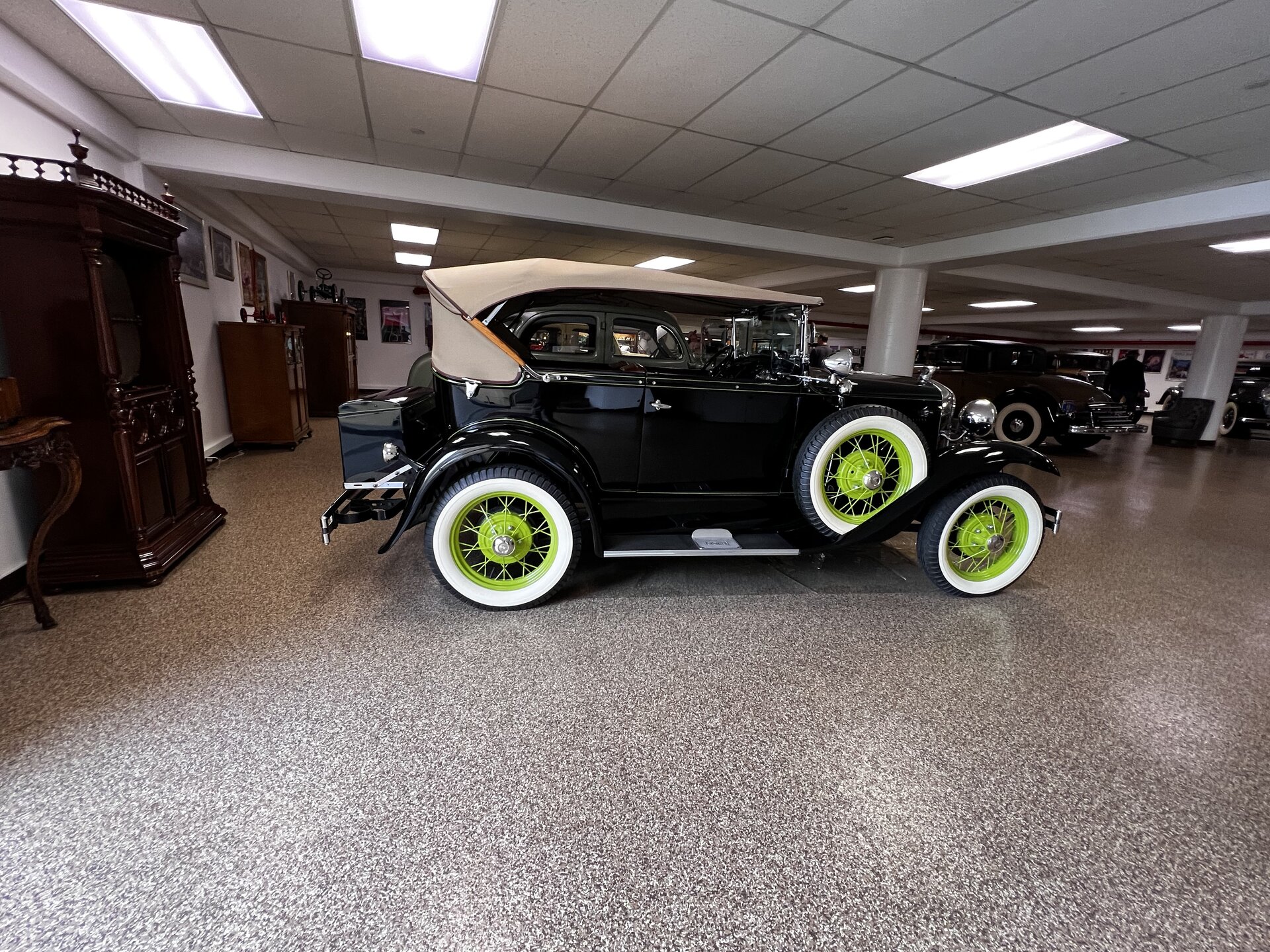
This is a Ford Model A, the car Henry Ford was forced to build when the Model T finally ran out of road. The T had put America on wheels: over fifteen million units between 1908 and 1927, half of every car on Earth at its peak, produced on the first moving assembly line at Highland Park. But by the mid-1920s Chevrolet was outselling it with a car that had a proper gearshift, a modern clutch, hydraulic-free four-wheel mechanical brakes, and colors other than black. Ford shut the River Rouge line down for six months in 1927 and re-tooled the entire company to build the Model A. It is one of the largest bet-the-company moves in industrial history.
Why the Model T had to die.
The Model T was a rolling monument to standardization. Two forward speeds via planetary gearset controlled by foot pedals, no accelerator pedal in the modern sense (a hand throttle on the steering column), no fuel pump (gravity fed from a tank under the front seat, meaning steep hills had to be climbed in reverse), magneto ignition, and a 20 horsepower 2.9 liter four. It was brilliant in 1908 and obsolete by 1925. Consumer expectations had moved on. Chevrolet's 1926 Superior Series K offered a conventional H-pattern three-speed, a real clutch, four-wheel mechanical brakes, and Duco lacquer paint in multiple colors. Ford's response, delayed by Henry Ford's personal attachment to the T, was to stop production entirely on May 26, 1927 with no replacement ready.
The retooling was a public event. Every major stamping, engine, and body die at River Rouge and the branch plants had to be replaced. Ford laid off or reassigned around 60,000 workers for months. The financial exposure was estimated at $250 million in 1927 dollars (roughly $4.5 billion today) with no revenue coming in. When the Model A was finally unveiled in Detroit on December 2, 1927, more than ten million Americans reportedly saw it in the first 36 hours. Ford had used the shutdown itself as a marketing campaign.
What the Model A actually was.
The Model A used a 3.3 liter L-head inline four making 40 horsepower, a conventional three-speed sliding-gear transmission with a proper clutch, four-wheel mechanical brakes, safety glass in the windshield as standard (a first for a mass-market American car), and a genuine dashboard with fuel gauge, ammeter, and speedometer. Top speed was around 65 mph, roughly double the Model T. It was offered in seventeen body styles and in colors: Niagara Blue, Arabian Sand, Rubelite Red, Andalusite Blue, Gunmetal Blue. The base Tudor sedan cost $500. A Roadster was $385. A Town Car with a chauffeur compartment was $1,200.
Between October 1927 and March 1932 Ford built just under 4.9 million Model As across those seventeen body styles. Peak production hit 9,000 cars per day. It was again the best-selling car in America by 1929, retaking the crown from Chevrolet. It was the first Ford exported in serious volume, assembled in plants in Germany, England, Argentina, Japan, and the Soviet Union, where the GAZ-A of 1932 was a licensed Model A that formed the base of Soviet motorization.
The engineering discipline behind the scale.
The lesson of the Model A is not the car itself. It is the operating philosophy. Ford refused to release it until every component was tooled for mass production at Model T unit costs. Safety glass had been available in Europe since 1919 but was hand-fitted at premium prices. Ford negotiated a supply deal with Libbey-Owens-Ford that let him make it standard equipment on a $500 car. The three-speed gearbox used stamped-steel synchronizer components that could be produced faster than machined ones. The body dies were designed so a single stamping press could produce panels for multiple body styles.
This is the discipline that separates real mass mobility from prestige engineering. Bugatti in the same era was hand-building perhaps 200 cars a year. Duesenberg would build 481 Model Js across its entire production run. Ford built 4.9 million Model As in 54 months. The Model A proves that scale is a design constraint, not a marketing outcome. You do not get to mass mobility by making a good car cheaper. You get there by designing every subsystem, from the door hinge to the crankshaft, to be manufacturable at target cost from day one.
The line to Outonomous.
The Model A is a receipt for the exact problem Outonomous exists to solve at the next layer. Ford's insight was that the existing installed base of horse-drawn transport was not going to be replaced one carriage at a time by hand-built prestige vehicles. It had to be replaced by a manufacturable, serviceable, affordable platform that ordinary owners and ordinary mechanics could keep running. That is why the Model A had a conventional gearbox and a real dashboard: it fit into the world that already existed, and it upgraded that world at scale.
Autonomy is at the same inflection point today. The prestige-engineering approach is to build purpose-built robotaxis from scratch, a few thousand units a year, at a unit cost that never reaches ordinary owners. That is the Duesenberg strategy applied to self-driving cars. It will not save 100 million lives because it does not touch the 1.6 billion vehicles already on the road. Outonomous is the Model A strategy applied to autonomy: a platform that installs on the existing fleet, respects the mechanics and owners who already service those vehicles, and makes Physical AI a standard feature the way safety glass became a standard feature in 1927. The Model A is proof that this is how transportation revolutions actually reach the public. The breakthrough is never just the invention. It is the manufacturing discipline that lets it scale.
"The Model T invented mass motoring. The Model A proved you could modernize it without losing the people who already depended on it. That is the harder problem, and it is the same problem autonomy has now."
Omar Mukhtar, field note
Background reading
For further reading: search the public record for Ford Model A, and visit the Nethercutt Collection, where Omar studied and photographed this material first-hand.
Copyright
Photographs © 2026 Outonomous. All rights reserved. Image rights are held by Outonomous and may not be reproduced without written permission.