Entry 029 · Nethercutt Collection · 1933
The 1933 Duesenberg Twenty Grand, the $20,000 SJ that stopped the Chicago World's Fair.
A supercharged Model SJ, coachbuilt by Rollston, displayed on a revolving stand at the 1933 Chicago Century of Progress. Its price on the plaque, $20,000, gave the car its name and made it the most expensive automobile in the world at the height of the Great Depression.
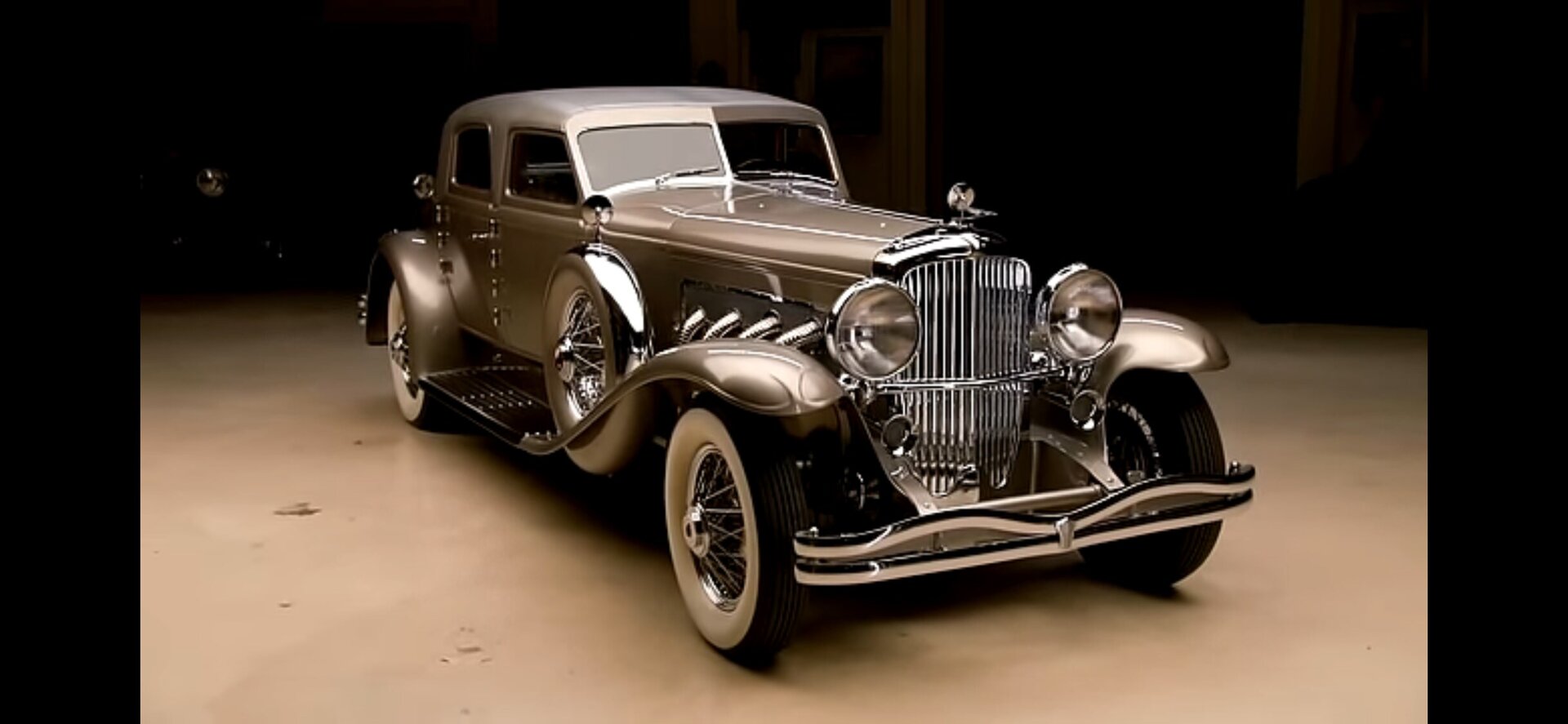
The 1933 Duesenberg SJ known as the Twenty Grand cost $20,000 in 1933. A Ford V-8 cost $460. A middle-class American house cost $5,000. Duesenberg took the most expensive chassis in the world, wrapped it in a Rollston Arlington Torpedo Sedan body, put it on a revolving stand at the Chicago Century of Progress International Exposition, and dared the country to look. In the depth of the Great Depression, they did.
The Model SJ.
The Duesenberg Model J was introduced in 1928 with a 6.9-liter dual-overhead-cam straight-eight engine rated at 265 horsepower, more than double any competitor. The supercharged Model SJ of 1932 pushed output to 320 horsepower and top speed to 129 mph in stripped configuration. In 1932 that was faster than every other production car in the world by a comfortable margin. The SJ was the fastest, most powerful, and most expensive American automobile ever built up to that date, and it held both records for the remainder of the decade.
Rollston and the Arlington body.
Rollston was a New York City coachbuilder that specialized in bodies for Duesenberg, Rolls-Royce, and Packard chassis in the late 1920s and early 1930s. The Arlington Torpedo Sedan design was a formal enclosed four-door with a swept fastback tail, a chauffeur's division window between the front and rear compartments, and a distinctly aerodynamic profile that was ten years ahead of the mainstream American body idiom. The car painted for the Chicago show was silver with dark blue accents.
Chicago, 1933.
The Century of Progress International Exposition ran from May 1933 to November 1934 on 427 acres along the Chicago lakefront. It attracted 48.7 million visitors. Cadillac, Lincoln, Packard, Pierce-Arrow, and Duesenberg all showed cars. Duesenberg's centerpiece was chassis 2538 with body number 336: the SJ Arlington that would become known as the Twenty Grand. The plaque next to the revolving stand read simply "$20,000." In 1933 dollars that was more than four times the median annual American household income. It was a statement. Duesenberg was saying to visitors, in the pit of the Great Depression, that American engineering could still produce a machine worth twenty thousand dollars.
What happened to the car.
After the Exposition the Twenty Grand was sold to Josiah Kirby Lilly Jr., president of Eli Lilly Pharmaceuticals in Indianapolis. It stayed in his family until the 1960s, then passed through a series of collectors, restorations, and concours appearances. In 2010 it won Best of Show at the Pebble Beach Concours d'Elegance, more than 75 years after Chicago. It is now part of the ACD Museum in Auburn, Indiana. The revolving-stand display in the photograph is a Nethercutt reconstruction of how the car was originally presented at the 1933 Exposition.
What Duesenberg was arguing.
By 1933 Duesenberg was in trouble. Its parent, the Auburn Automobile Company under Errett Lobban Cord, was one of the largest automotive conglomerates in the world (Auburn, Cord, Duesenberg, Lycoming engines, Stinson aircraft, American Airways), but the Depression was eating the luxury market alive. The Twenty Grand at Chicago was partly a technical statement and partly a marketing argument that Duesenberg was not going to compromise its way through the Depression. Duesenberg produced its last car in 1937. E. L. Cord's empire collapsed in 1937 and was liquidated. The Twenty Grand was the last major promotional push of the greatest American luxury marque of the 20th century.
The lesson.
The Twenty Grand is a reminder that engineering excellence and commercial survival are not the same problem. Duesenberg built the best car in America and did not survive the decade. The Model T was cheap and terrible and outlived it. That trade-off is the discipline of building at scale. Outonomous is building the Physical AI platform for the installed base because the platform is the leverage: get the mission (100 million lives saved) onto the vehicles the world already owns, and the arithmetic works. Build only 500 Twenty Grands and the arithmetic never closes, no matter how magnificent each one is.
"Twenty thousand dollars in 1933. On a revolving stand. In Chicago. Duesenberg made an argument. History remembered it. The company did not survive it. Excellence alone is not enough."
Omar Mukhtar, field note
Background reading
For further reading: search the public record for 1933 Duesenberg SJ Twenty Grand, and visit the Nethercutt Collection, where Omar studied and photographed this material first-hand.
Copyright
Photographs © 2026 Outonomous. All rights reserved. Image rights are held by Outonomous and may not be reproduced without written permission.