Entry 012 · Nethercutt Collection · Field study
The first motor trip and the motor car as proof, not theory.
The motor car became real when it left the workshop and completed a journey. The first long trip converted an invention into infrastructure, fuel logistics, maintenance discipline, and public trust.
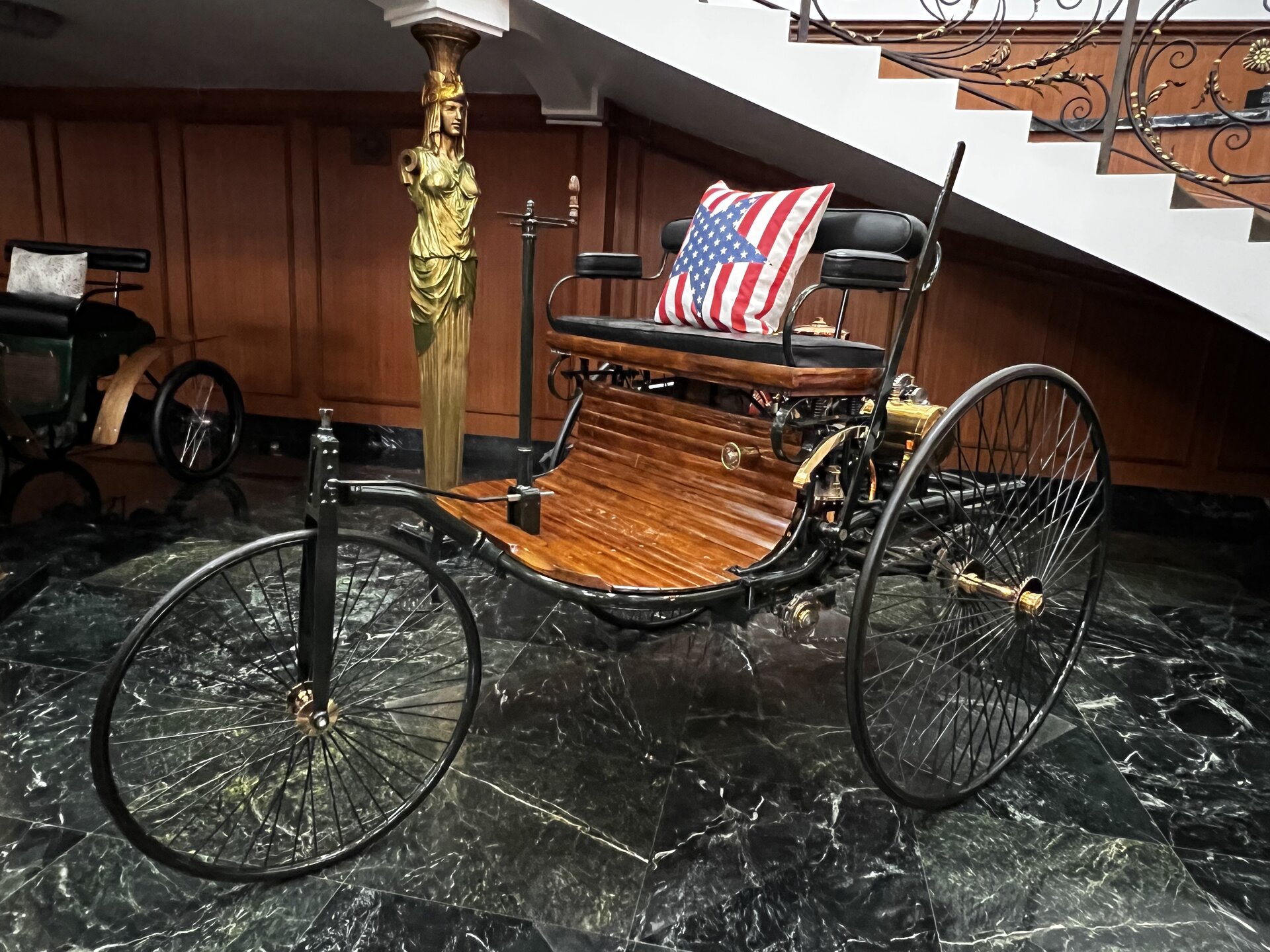
first motor trip and motor car belongs in the Explorations archive because it makes a transportation decision visible. Some machines matter because they invented a category. Others matter because they clarified a subsystem, a manufacturing method, a control philosophy, or a public desire that later became normal. This vehicle is one of those receipts. It shows how motion, power, identity, and trust were being negotiated in metal before software became the layer everyone could see.
Field notes
- Entry
- 012
- Subject
- first motor trip and motor car
- Series
- Explorations
- Source
- First-hand photograph
- Omar Mukhtar
Why this machine is not just a museum object.
A preserved machine can be treated as decoration, or it can be read as evidence. The second approach is the only one that matters here. first motor trip and motor car records an engineering judgment made under the limits of its own time: available materials, workshop skill, roads, fuel, braking, passenger expectations, maintenance habits, and the public's willingness to trust a moving machine. Those constraints are not quaint. They are the same class of constraints that shape every serious mobility platform today.
The visible surface is only the entry point. Body line, wheelbase, lamp position, seating height, access panel, engine placement, steering geometry, cabin trim, and cooling path all reveal what the builder thought the machine was for. If the object is grand, it tells us what power wanted to look like. If it is small, it tells us how usefulness had to be packaged. If it is a component, it tells us which invisible subsystem was important enough to isolate and preserve.
The control problem behind the form.
Every important vehicle is a control system before it is a style object. It has to start, move, turn, stop, cool, communicate, and survive abuse from the road and the driver. The early automobile solved those problems mechanically. Linkages, cables, gears, magnetos, carburetors, springs, lamps, gauges, and human senses formed one loop. The driver was not outside the system. The driver was the processor, the sensor fusion layer, and the fallback plan.
That is why first-hand study matters. A photograph taken in the room catches relationships that a specification table often misses: how close the wheels sit to the body, how exposed a linkage is, how the driver sees over the hood, how much service access the maker allowed, how the machine announces status, and how much confidence it asks from the person using it. Those details are the operating system of the pre-digital car.
What changed because machines like this existed.
Transportation history does not move in a straight line from primitive to modern. It moves through experiments. Some experiments win by becoming universal. Some fail commercially but leave a subsystem behind. Some exist as proof that the public wanted a different kind of mobility before the industry was ready to supply it at scale. first motor trip and motor car has to be read inside that pattern, as part of the long argument over how much power, comfort, risk, visibility, and mechanical complexity society would accept.
The archive is built entry by entry because no single machine explains the full arc. Benz makes the automobile category legible. Eisenach makes corporate lineage legible. Duesenberg makes braking legible. Owen Magnetic makes the drivetrain legible. Packard, Bentley, Bugatti, Rolls-Royce, Porsche, Ford, Renault, and the working vehicles each expose a different layer. Put together, they show the installed base of human mobility as a stack of decisions, not a neutral background.
The line to Outonomous.
The relevance to Outonomous is direct. Outonomous is building the platform turning the planet's 1.6 billion existing vehicles into autonomous machines. That mission starts from the same premise this archive proves again and again: the vehicle already on the road is not obsolete because it lacks one layer. It is a working physical platform waiting for better perception, prediction, planning, and execution.
The old problem was mechanical trust. Could the car start, steer, stop, cool, and carry people without destroying itself or them? The present problem is autonomy trust. Can the vehicle perceive the world, predict risk, plan motion, and execute safely on roads built for human drivers? Those are different technologies, but they are not different disciplines. They both require reading the full system instead of worshipping the most fashionable part.
That is why this series keeps returning to the installed base. New vehicles alone will not solve the scale of road safety. The existing fleet is the battlefield. The goal is 100 million lives saved by putting Physical AI onto the vehicles that already exist. first motor trip and motor car matters because it is another receipt from the long history of transportation progress: the breakthrough is never just the object. It is the missing layer that lets the object become safer, more useful, and more trusted.
"The machine is never only the machine. It is a record of what people thought motion could safely become."
Omar Mukhtar, field note
Background reading
For further reading: search the public record for first motor trip and motor car, and visit the Nethercutt Collection, where Omar studied and photographed this material first-hand.
Copyright
Photographs © 2026 Outonomous. All rights reserved. Image rights are held by Outonomous and may not be reproduced without written permission.